
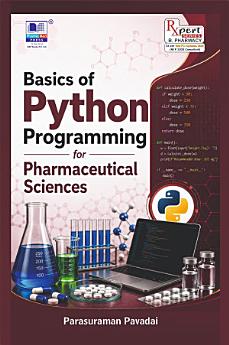


Description
The field of Pharmaceutical Sciences is undergoing a rapid transformation, shifting from a traditionally laboratory-oriented discipline to a Data-Driven, Technology-Enabled, and Computationally Empowered domain. In the contemporary academic and professional landscape, Pharmacy graduates are expected to possess not only foundational knowledge in Medicines, Formulations, Pharmacokinetics, Pharmacovigilance, and Clinical DecisionMaking but also competencies in data management, the use of digital tools, scientific interpretation, and the application of Computational Thinking. Within this framework, Python has established itself as one of the most versatile, beginner-friendly, and broadly applicable programming languages for Pharmaceutical Education and Research. This book, Basics of Python Programming for Pharmaceutical Sciences, has been prepared in accordance with the New Pharmacy Council of India (PCI) Syllabus, aligned with the vision of the National Education Policy (NEP).The content is designed to support Skill-Based, Outcome-Oriented, Multidisciplinary, and Application-Driven Learning. The book aims to introduce Python Programming in a simple, structured, and pharmacyoriented manner, particularly for students who are encountering programming for the first time. Unlike conventional programming textbooks, this publication connects each major Python concept to examples directly sourced from the Pharmaceutical Sciences. These encompass Dose Calculation, Clinical Decision Support, Adverse Drug Reaction Analysis, Pharmacokinetic Data Management, Dissolution Profiling, Inventory Control, Structured Data Analysis, and Scientific Data Visualization. This methodology facilitates learners’ understanding not only of Python programming but also of its meaningful applications in Pharmacy Education, Research, and Practice.
The textbook is systematically organized to accommodate beginners. Unit I emphasizes the importance of Python in Pharmaceutical Sciences and explains fundamental programming concepts. Unit II focuses on control structures and functions, illustrated through decision-making scenarios in clinical and pharmacy contexts. Unit III covers data structures and file handling, with practical applications such as medication lists, patient records, and pharmaceutical datasets. Unit IV introduces Pandas for structured data management, including data cleaning, filtering, grouping, and analysis. Unit V explores Matplotlib for scientific data visualization, covering line plots, bar charts, histograms, scatter plots, box plots, and publication-quality pharmaceutical graphs. Special care has been taken to present the subject in Student-Friendly Language, supported by relevant examples, figures, tables, code snippets, program outputs, and scientific interpretations.
The book also emphasizes good Scientific Communication – including correct labelling of graphs, use of appropriate units, proper interpretation of results, and structured presentation of data. These elements are essential for developing Digital Competency, Data Literacy, Problem-Solving Ability, and Research Readiness among pharmacy students.
This book will be of value to Undergraduate Pharmacy Students, Postgraduate Students, Research Scholars, Faculty Members, and anyone who wishes to apply Python to Pharmaceutical Chemistry, Pharmaceutics, Pharmacology, Clinical Pharmacy, Pharmaceutical Data Analysis, or Computational Drug Discovery. It is intended to serve as a practical foundation that enables learners to develop confidence in Python Programming and to apply it effectively in academic, research, and professional settings.




Reviews
There are no reviews yet